
Category: Kings of the Bible

  • King David

    If Saul is the Bible’s great tragedy, David is its greatest epic. He is the only person described in Scripture as a “man after God’s own heart,” yet he is also one of its most flawed heroes. His life is a study in the heights of spiritual devotion and the depths of human moral failure.


    1. The Shepherd Poet (Preparation)

    David was the youngest of Jesse’s eight sons in Bethlehem. While his brothers were soldiers, David was a shepherd—a lowly job that taught him the two skills that would define his life:

    • Worship: He spent his solitude writing poetry and playing the harp, composing many of the Psalms (like the famous Psalm 23).
    • Warfare: Protecting sheep from lions and bears developed his expertise with the sling, a weapon typically used by shepherds.

    When the prophet Samuel came to anoint a new king, he looked at David’s tall, impressive brothers. But God told him: “The Lord does not look at the things people look at… the Lord looks at the heart” (1 Samuel 16:7).


    2. The Giant Killer (The Turning Point)

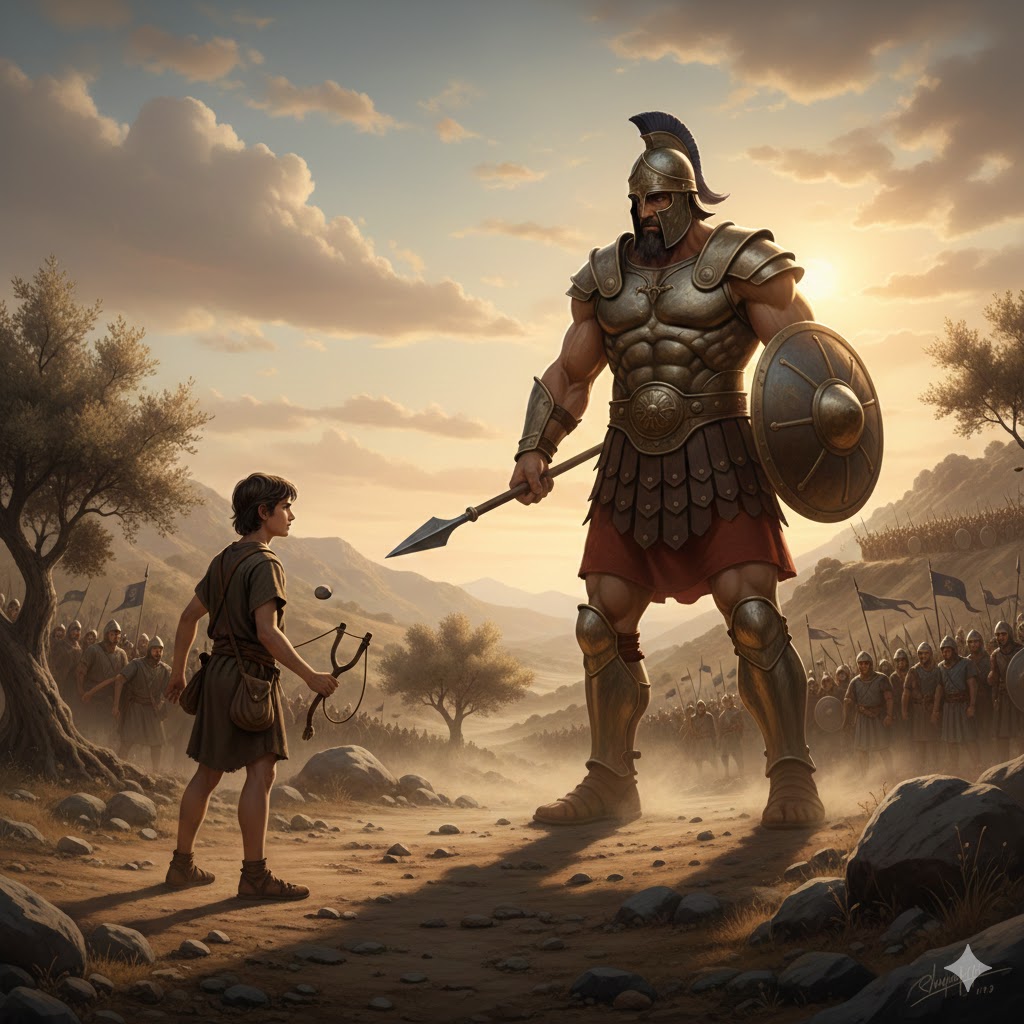
    David’s public life began when he visited his brothers on the battlefield. The Philistine giant Goliath had been mocking Israel for 40 days. While the professional soldiers were paralyzed by fear, David was indignant that anyone would defy “the armies of the living God.”

    • The Victory: Armed only with five smooth stones and a sling, David killed Goliath. This moment marked his transition from a shepherd boy to a national hero.
    • The Cost: His success sparked King Saul’s lethal jealousy, forcing David to spend over a decade as a fugitive in caves and deserts.

    3. The Unifying King (The Golden Age)

    After Saul’s death, David was eventually anointed King of all Israel. His reign is considered the “Golden Age” of the nation:

    • Jerusalem: He captured a Jebusite fortress and made it the capital city, often called the “City of David.”
    • The Ark of the Covenant: He brought the Ark to Jerusalem, making the city the spiritual heart of the nation. He was so joyful during this event that he famously “danced before the Lord with all his might.”
    • The Davidic Covenant: God promised David that his lineage would endure forever. For Christians, this is seen as the prophecy that the Messiah (Jesus) would be a “Son of David.”

    4. The Great Fall and Repentance

    David’s legacy is permanently scarred by his affair with Bathsheba.

    • The Sin: While his army was at war, David stayed behind, saw Bathsheba bathing, and took her. To cover the resulting pregnancy, he orchestrated the murder of her husband, Uriah the Hittite.
    • The Confrontation: The prophet Nathan confronted David with a parable, leading David to a state of total brokenness.
    • The Legacy of Mercy: Unlike Saul, who made excuses for his sins, David repented completely. His prayer of confession, Psalm 51, remains the biblical standard for seeking God’s mercy.

    5. Later Years and Family Turmoil

    The consequences of David’s sins haunted his family life:

    • Absalom’s Rebellion: His own son, Absalom, led a civil war to overthrow him. David was forced to flee his own capital and was heartbroken when Absalom was killed in the fighting.
    • Succession: In his final days, David secured the throne for his son Solomon, charging him to walk in the ways of the Lord.
  • King Saul

    King Saul is one of the most tragic figures in the Bible. His story, found in the book of 1 Samuel, follows a dramatic arc from a humble, chosen leader to a paranoid, rejected king.

    The Rise of the First King

    Before Saul, Israel was a loose confederation of tribes ruled by “Judges.” As the people clamored for a king to be “like other nations,” God directed the prophet Samuel to anoint Saul, the son of Kish from the tribe of Benjamin.

    • Physical Stature: Saul was “tall, dark, and handsome”—literally a head taller than anyone else in Israel (1 Samuel 9:2).
    • Initial Humility: When it was time for his public coronation, he was so shy that he was found hiding among the baggage.
    • Military Success: Early in his reign, Saul was a brilliant commander. He famously rescued the city of Jabesh-Gilead from the Ammonites, a victory that solidified his support across the tribes.

    The Downfall: Sacrifice and Disobedience

    Saul’s decline was not a single event but a series of choices where he chose human approval or his own logic over divine instruction.

    1. The Unauthorized Sacrifice: Before a battle with the Philistines, Saul grew impatient waiting for Samuel to arrive and perform the required ritual. He took it upon himself to offer the sacrifice—a role strictly reserved for priests. Samuel rebuked him, announcing that his kingdom would not endure.
    2. The Amalekite Failure: God commanded Saul to completely destroy the Amalekites. Instead, Saul spared their king, Agag, and kept the best of the livestock. When confronted, he blamed his soldiers, saying they wanted the animals for sacrifices. Samuel famously replied: “To obey is better than sacrifice.”

    Saul and David: The Descent into Madness

    The later years of Saul’s life were defined by his obsession with David, the young shepherd who killed Goliath.

    • Jealousy: After David’s victory, the women sang, “Saul has slain his thousands, and David his ten thousands.” This sparked a murderous envy in Saul.
    • Paranoia: Saul suffered from “an evil spirit” (likely what we would today describe as deep depression or psychosis). Ironically, David was brought into the palace to play the harp to soothe him, yet Saul tried to spear him several times while he played.
    • The Medium of Endor: In his final act of desperation before his last battle, Saul consulted a medium (a witch) to summon the spirit of the deceased Samuel for advice—a practice he himself had banned.

    The Death of Saul

    Saul met his end on Mount Gilboa during a crushing defeat by the Philistines.

    • The Battle: Seeing his sons (including David’s best friend, Jonathan) killed in battle and realizing he was about to be captured, Saul asked his armor-bearer to kill him.
    • The End: When the armor-bearer refused, Saul fell on his own sword. The Philistines later desecrated his body, but the men of Jabesh-Gilead—the city he had saved at the start of his reign—risked their lives to recover his remains and give him a proper burial.

    The Life and Lessons of King Saul

    This video provides a visual overview of Saul’s transition from a humble leader to a tragic king, highlighting the consequences of his leadership choices.